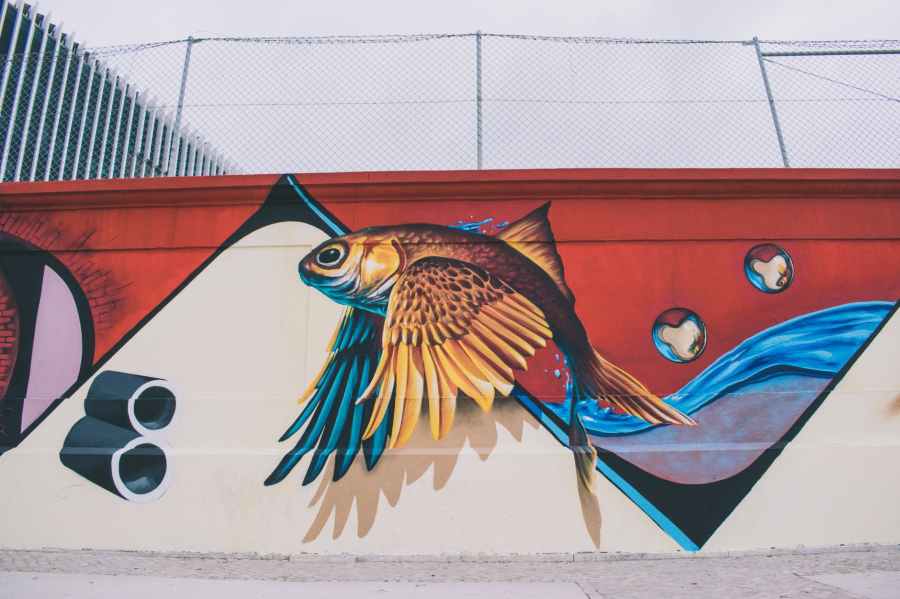
My research team had conducted a study on the potential forms of Islamic Public Art a couple of years back. Graffiti, street art and murals have always been one of my fascinations when it comes to urban design and public space. The large-scale sprayed or painted drawings and writings on the walls can definitely capture my attention from afar. I can remember those days when my husband and I visited Hosier Lane in Melbourne, sometimes on our detour after coming back from campus (me) and work (him), and other times to bring our friends when they visited. Hosier Lane is regulated in some ways, and Melbourne even has a Graffiti Management Plan. For Malaysia, Think City recently in Jan. 2019 shared A Guide for Public Arts Project (you can download the booklet, it’s free).
I later came across a unique type of street art termed ‘calligraffiti’. While searching further on this, I stumbled upon eL Seed, a French-Tunisian artists who (as written in TED), ‘blends the historic art of Arabic calligraphy with graffiti to portray messages of beauty, poetry and piece across all continents’. Another artist is Aerosol Arabic, who infused Islamic scripts and Islamic messages in street art. These examples and a few others show that Islamic-themed graffiti has grown to be accepted as a form of public art, while expressing messages of faith and humanity.
Experimenting with Islamic-Themed Graffiti
One part of our research was to test how the university community would respond to Islamic-Themed Graffiti. Our research team coordinated a public art project, which involved a graffiti artist as a mentor and students as members of the community. Three graffiti artists that we had the opportunity to work with were Anokayer, EscapeVA and Bone Alfie – all whom were introduced to us by Julie and Christine from Bumblebee.
We wanted the content of the artwork to be community-driven, so the students contributed their ideas and the graffiti artist helped to refine the ideas, then coached them on how to do the graffiti using the spray paints. The completed artworks were then placed at a central area of the campus. From time to time, we observed how people interacted with the artwork, such as from checking our Instagram hashtag and physically going there to see what people do. We also conducted a survey on 200 respondents. 78% are Muslims, 22% are Non-Muslims, 94.5% are Malaysians, and 5.5% from other countries.
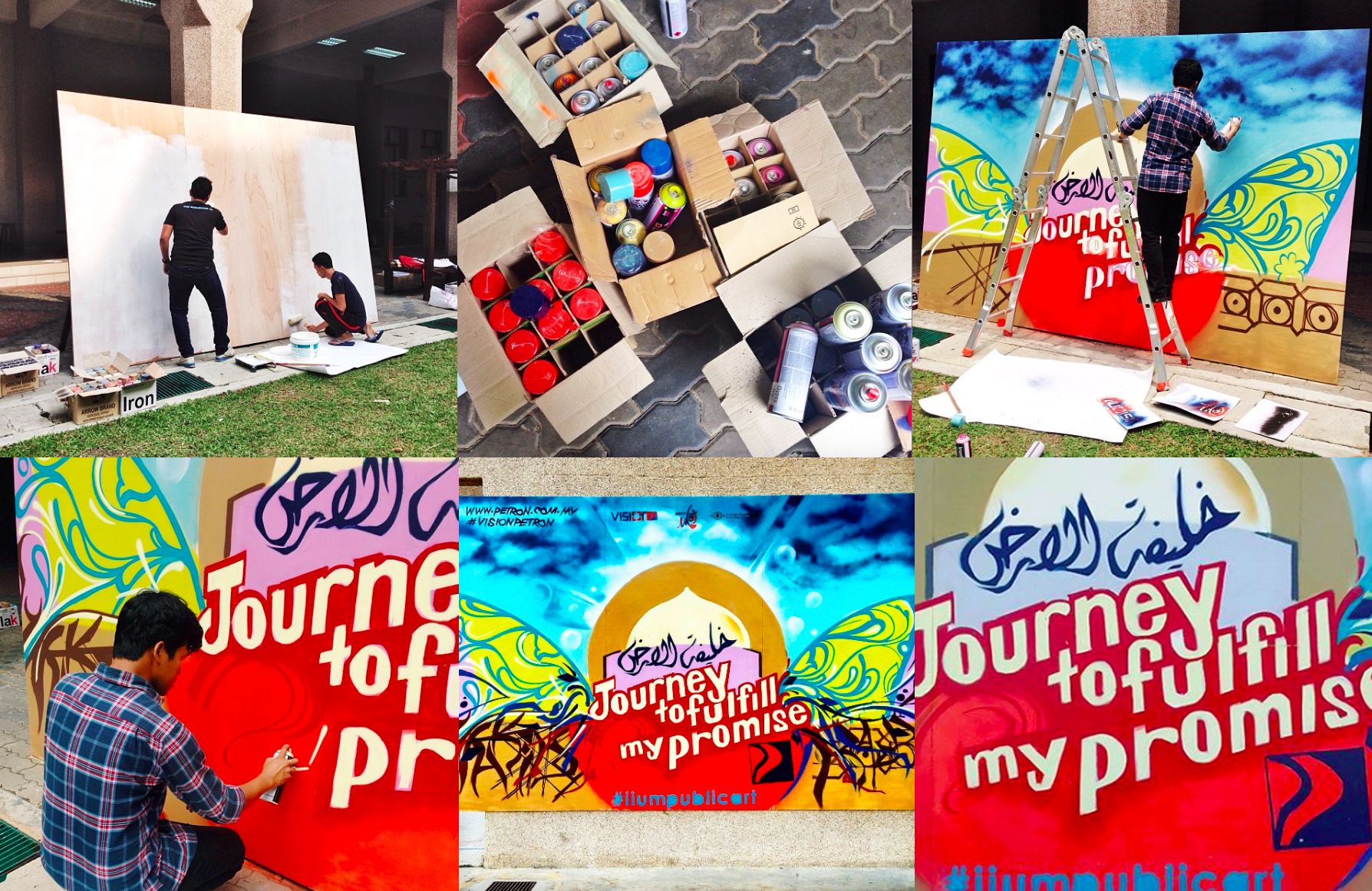
(This project was funded by Vision Petron and MIRGS Research Grant with permission from the University)
So what were the take-aways?
Can graffiti artwork become a medium to spread positive message to the society? YES.
The survey respondents felt that public art is an artwork that delivers a certain message to the public, through the colours, forms, textures and patterns. While about half of the respondents (55%) agreed that graffiti can be considered as a form of public art, about one-third of them (35.5%) expressed that it would depend on the artwork.
For the artwork “Khalifatul Ardh” (written in Arabic calligraphy) and “Journey to Fulfill [sic] My Promise”, the readable texts make it very clear of the message the artwork was projecting. The intention of the words was to remind people that we are stewards of this earth and each of us has our duties and responsibilities to fulfil our promise as a responsible human being. The message of the artwork was clearly understood by the respondents. The Muslim respondents interpreted the message as a reminder of the journey of one’s self towards God, our role as a Khalifah (vicegerent), duty as servants of Allah, as well as a sense of freedom and responsibility. The non-Muslim respondents also had a similar interpretation of the artwork, where they read the message as the journey to fulfil one’s promise, Muslims to fulfil their promise to God, journey of the artist to fulfil his/her promise, and journey to Makkah. This was definitely an interesting finding because there was no indication of the word God or Makkah in the artwork.
The artworks were placed on the walls of buildings at the central area of the campus, next to cafes. We left the artwork on the walls for more than a year in order for us to conduct the survey and also to observe the activities that would take place near the artwork. From the survey, respondents felt that the artworks made the space lively. Not long after the artworks were placed, people took photos with the artwork and a band also performed in front of it – the artworks as a backdrop, possibly. A bench was also placed in front of the artwork, as the spot also had a tree that gave good shade. From Instagram, we found some people responded to the artwork with captions such as “your journey is yours, it’s not a competition”, “sometimes we need a change to go ahead”, and “Journey to fulfill my promise. Our promise. I promise.”
When asked about what the respondents would suggest as potential themes for graffiti artworks, both Muslims and non-Muslim shared similar ideas. They felt that graffiti artworks should promote messages on humanity, unity, good deeds, moral values and love. This particular finding reinforced that as humans, regardless of religion, culture and gender, good values are universal. Art in the public space can definitely become a medium to communicate good values in a creative way.
These findings were extracted from a publication titled “Islamic-Themed Graffiti: Potentials of Public Art with Islamic Attributes”.
 PLACE RESEARCHER